dAppBooster for Canton

A local Canton dev loop, end to end.

What an EVM developer gets from a CLI toolkit, a browser wallet, and a frontend starter, now for Canton: a self-custodial browser wallet, a local participant and synchronizer, and a wallet-service bridge that executes real approval flows on your laptop. No OIDC, no production backend, no external access approvals.

npx dappbooster --canton
Canton Core surrounded by orbiting stack components: DAR, FRONTEND, EXAMPLES, CIP-103, WALLET, BACKBONE. DAR FRONTEND EXAMPLES CIP-103 WALLET BACKBONE CANTON · CORE
The Stack

What dAppBooster gives you

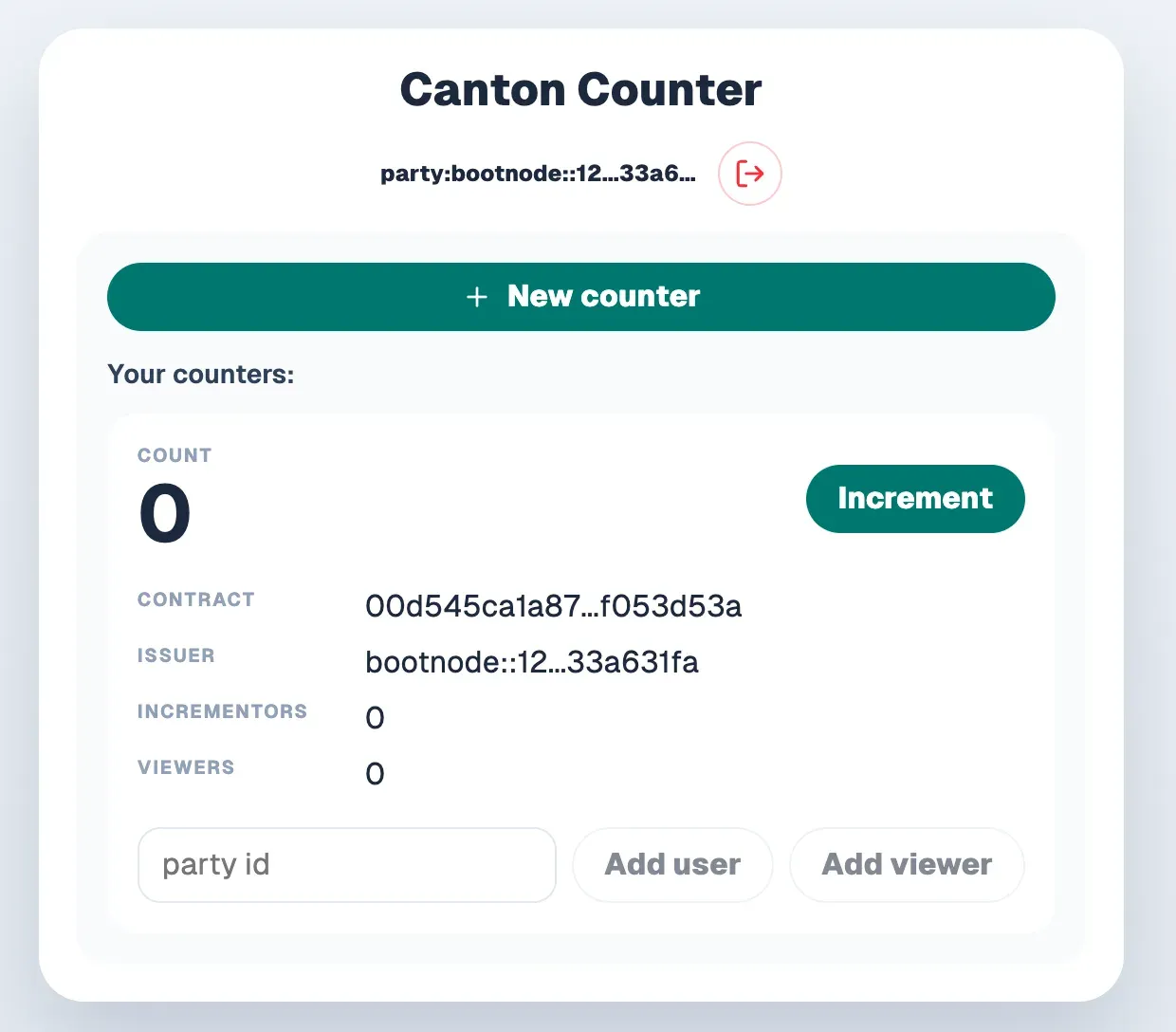
dAppBooster includes an end-to-end example. Run it, fork it, or read it as a starting point. The example exercises every step of the loop: write a Daml template, deploy the DAR, pair the browser wallet, and sign a real Canton transaction.

Local dev loop

Transmission path

  1. canton-barebones

    local participant + synchronizer

  2. carpincho

    self-custodial browser wallet

  3. wallet-service

    CIP-0103 bridge

  4. react-starter

    ready-to-start React frontend

  5. dApp

    end-to-end Canton dApp

dappbooster @ canton > capabilities --list

With the current stack, a developer can:

  • Run a local Canton participant and synchronizer.
  • Deploy a Daml DAR.
  • Connect a browser wallet to a dApp.
  • Create external parties from browser-held public keys.
  • Keep private keys inside the browser wallet.
  • Prepare, sign, and execute Canton transactions.
  • Test dApp flows without OIDC or a production backend.

The goal is fast iteration: write Daml, deploy it locally, connect a dApp, and verify that a real wallet approval flow executes Canton transactions.

Build from

Components

Each piece of the stack runs locally and ships with the source you need to fork it for your own dApp.

CO/01

canton-barebones

Minimal Canton infrastructure layer.

Includes

  • Canton participant
  • Local synchronizer
  • Postgres
  • JSON Ledger API
  • Local dev token generation
  • DAR deployment scripts
  • Health checks

Intentionally excludes Keycloak/OIDC, PQS, SV infrastructure, business backend, official wallet, Splice, frontend app.

The base stays small and predictable. A developer can start from a working Canton runtime and add only the pieces they need.

View on GitHub
CO/02

Carpincho

Self-custodial browser wallet · CIP-0103 (Sync dApp API)

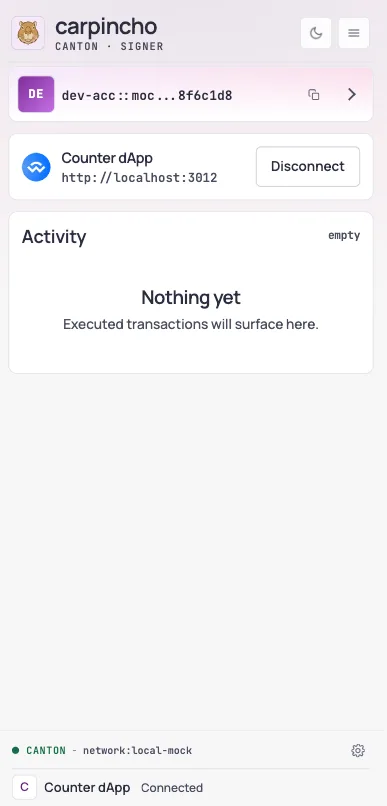
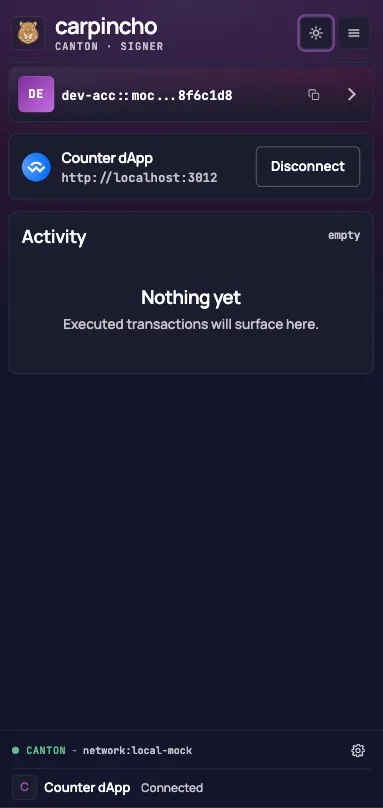
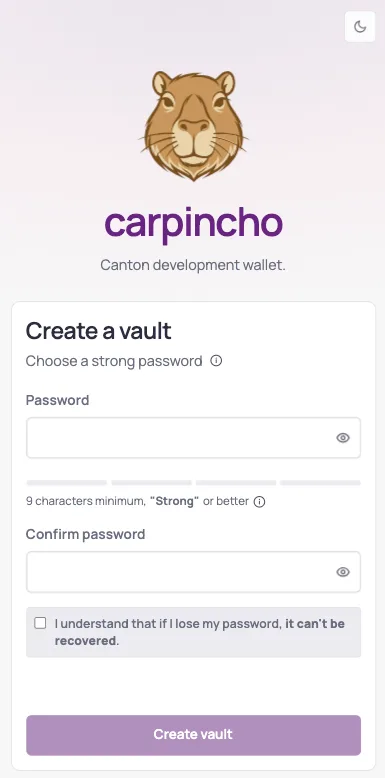
Carpincho implements the CIP-0103 dApp API. The wallet creates an Ed25519 key in the browser, stores the private key locally, and exposes wallet-provider behavior to dApps (connect, listAccounts, signMessage, prepareExecute, ledgerApi). When a transaction is prepared, the user approves it in the wallet, and Carpincho signs the prepared Canton hash locally.

The private key never leaves Carpincho.

View on GitHub
CO/03

wallet-service

A temporary bridge between Carpincho and Canton · CIP-0103 (Async dApp API)

wallet-service exposes the CIP-0103 operations Carpincho needs while we are still before the wallet-gateway migration: external party creation, transaction preparation, user-approval handoff, local signing, and execution of signed prepared transactions.

Does not store private keys. Does not contain example-specific business logic.

View on GitHub
CO/04

react-starter

Ready-to-start React frontend for Canton dApps.

react-starter uses the Canton dApp SDK to connect to a wallet provider, build generic Daml commands, list accounts, read ledger state, and approve transactions. It includes the example pre-wired, but works with any Daml application, not just the example.

Does not store private keys. Does not depend on example-specific wallet plumbing.

View on GitHub
CO/05

Example

An end-to-end Canton dApp.

The example exercises every step of the loop: a Daml template, a DAR deploy, a paired browser wallet, and a signed Canton transaction. Fork it as the starting point for your own dApp.

View on GitHub
The Approach

Two starting points

The official Canton Network Application Quickstart is a complete enterprise-style demo built by Digital Asset. It is scaffolding for shipping a real Global Synchronizer application, and includes preconfigured users, known parties, OIDC login via Keycloak, a Spring Boot backend service, PQS instances, JSON Ledger and Validator admin APIs, App Name Service and Scan UIs, an end-to-end install / license / renew workflow, an observability stack (Grafana, Prometheus, Loki, Tempo), and a multi-actor local network (built on Splice LocalNet) closer to production.

That is useful when the goal is to understand the full production-oriented stack.

dAppBooster solves a different problem: a fast Canton dApp development loop.

The two starting points differ in shape

  • 01 Quickstart
    login Canton user party rights backend-mediated app
  • 02 dAppBooster
    browser wallet key external party cryptographic signature Canton transaction

Parties are still central. We are not removing the Daml party model. We are simplifying the user layer during local development, so an individual developer can write Daml, deploy a DAR, and execute a real wallet approval flow without standing up Keycloak, a Spring Boot backend, or PQS.

Current tradeoffs

dAppBooster Canton v1 has one deliberate scope cut to keep the dev loop fast: wallet-service uses a single technical Canton user to talk to the Ledger API. That is acceptable for local development. It is not the right production model.

The issue is permission scoping. The technical user can accumulate rights over parties created during testing.

  • 01 Writes Protected

    External signatures protect every write. wallet-service cannot construct a valid transaction signature without Carpincho, and Carpincho only signs after the user approves in the wallet.

  • 02 Reads Sensitive surface

    A broad backend token can read more than a user-scoped wallet session should.

Open source and contribute

  • 01 License

    dAppBooster Canton is open source under the MIT License. Repository: github.com/BootNodeDev/cn-dappbooster.

  • 02 Lineage

    Built on dAppBooster for EVM.

    dAppBooster for Canton did not appear out of nowhere. The EVM-side dAppBooster has been shipping and improving with web3 builders for years. The Canton version is built by the same team and applies the same architecture, best practices, and developer-experience lessons, adapted for the Canton ecosystem.

Building dApps with dAppBooster Canton

Frequently Asked Questions

Common questions about what dAppBooster Canton is, how it fits next to the official Canton tooling, and what the local dev loop looks like in practice.